Amazon Music x Pratt Design Challenge
Amazon Music challenged our team to design a customer experience strategy that drives awareness, acquisition, and retention among passionate music fans. We designed FanClub, a community-first feature that turns live music moments and social discovery into acquisition, and fan belonging into retention. Our solution was built around two distinct user personas and two high-intent entry points, a QR scan at a live festival and a deep link from Prime Video, converging inside a shared fan community experience inside Amazon Music.
4 Weeks
4 UX Designers
Product Designer & User Researcher
Academic, Amazon Music
Figma, Condens
User Interviews, Surveys, Secondary Research, Competitive Analysis, Personas, Storyboarding, Thematic Analysis, Wireframing, Prototyping, Usability Testing, Iterative Design, Interaction Design
Challenge
The Design Prompt: "We seek a customer experience strategy to drive awareness and acquisition through improved discovery touchpoints and exceptional first-use experience. Tell us a story: how does someone who's never heard of Amazon Music — or has overlooked it — discover it, understand its value, and become an active listener?
We distilled this into three key business goals for Amazon Music
Key Business Goals
Increase Brand Awareness
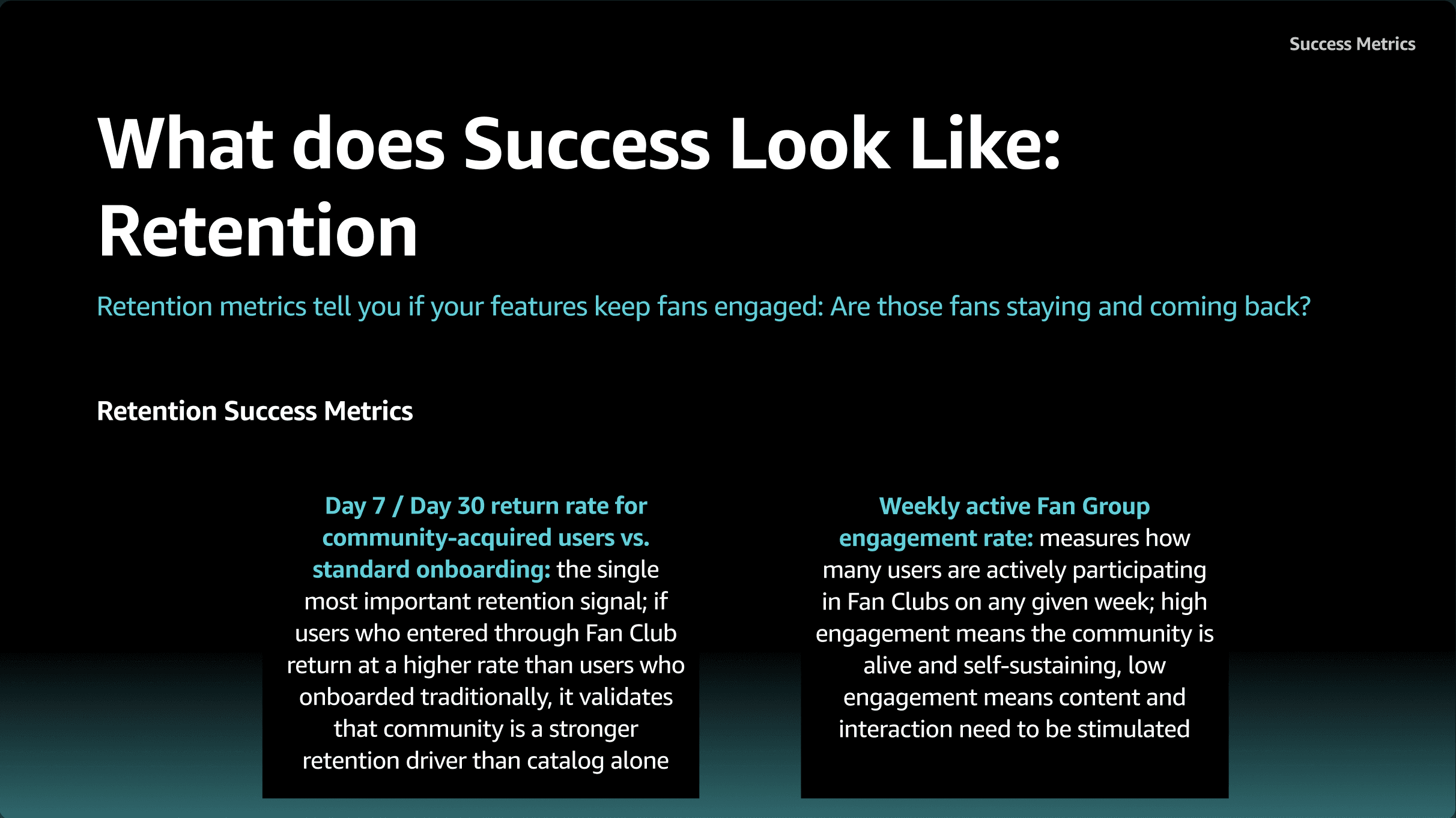
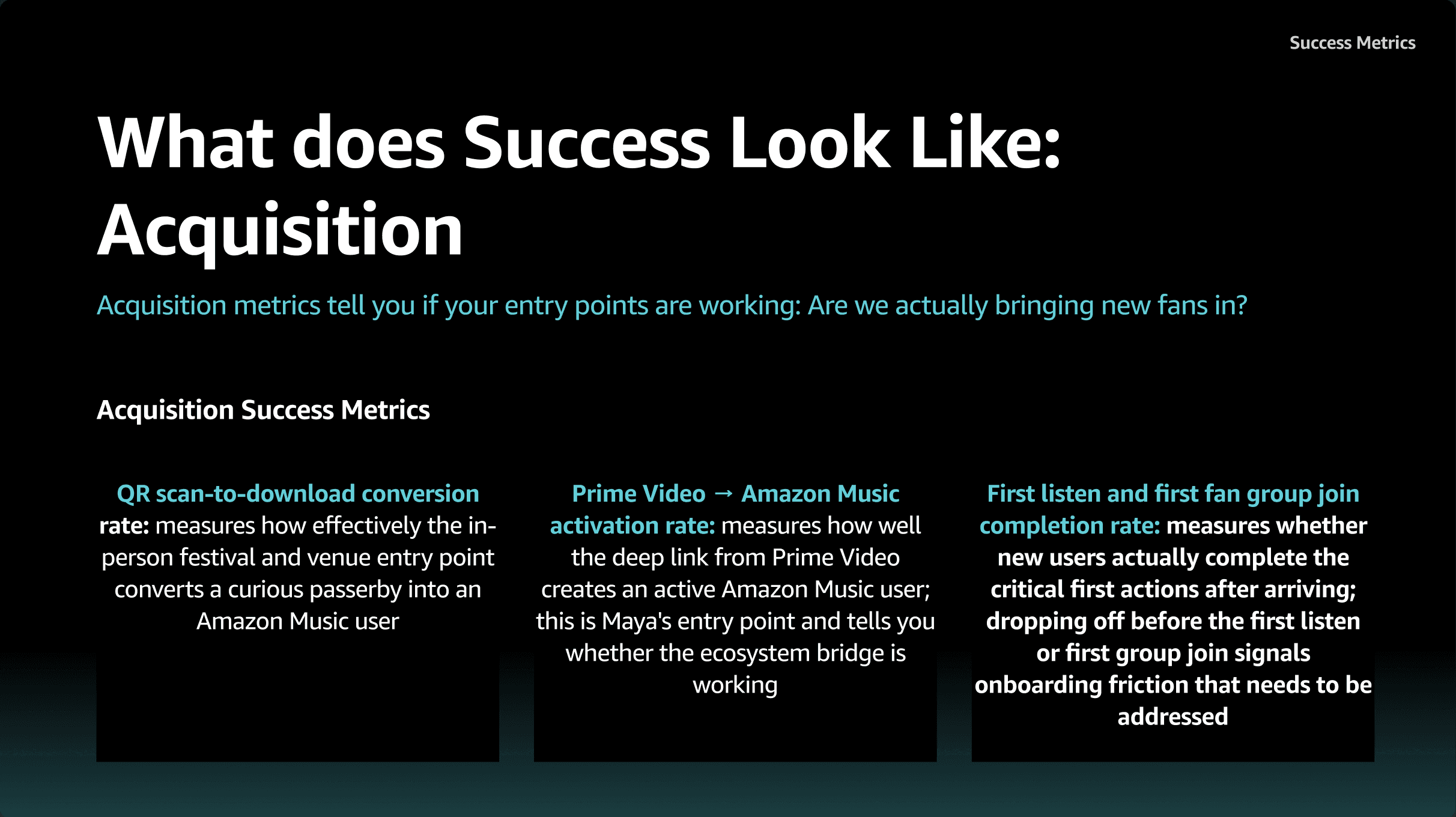
Prioritize New User Acquisition and Retention
Differentiate Amazon Music
Process
We followed a four-phase design thinking process:
Phase 1 — Discover: Uncover user needs, pain points, and behaviors through initial research. Methods: secondary research, surveys, user interviews.
Phase 2 — Define: Define a problem statement and hone in on key issues and opportunities. Methods: thematic analysis, personas.
Phase 3 — Develop: Begin developing potential features. Methods: competitive analysis, storyboarding, wireframing, prototyping.
Phase 4 — Deliver: Test designs and iterate to create a final high-fidelity prototype. Methods: moderated usability testing.
Research & Discovery
How We Got Here
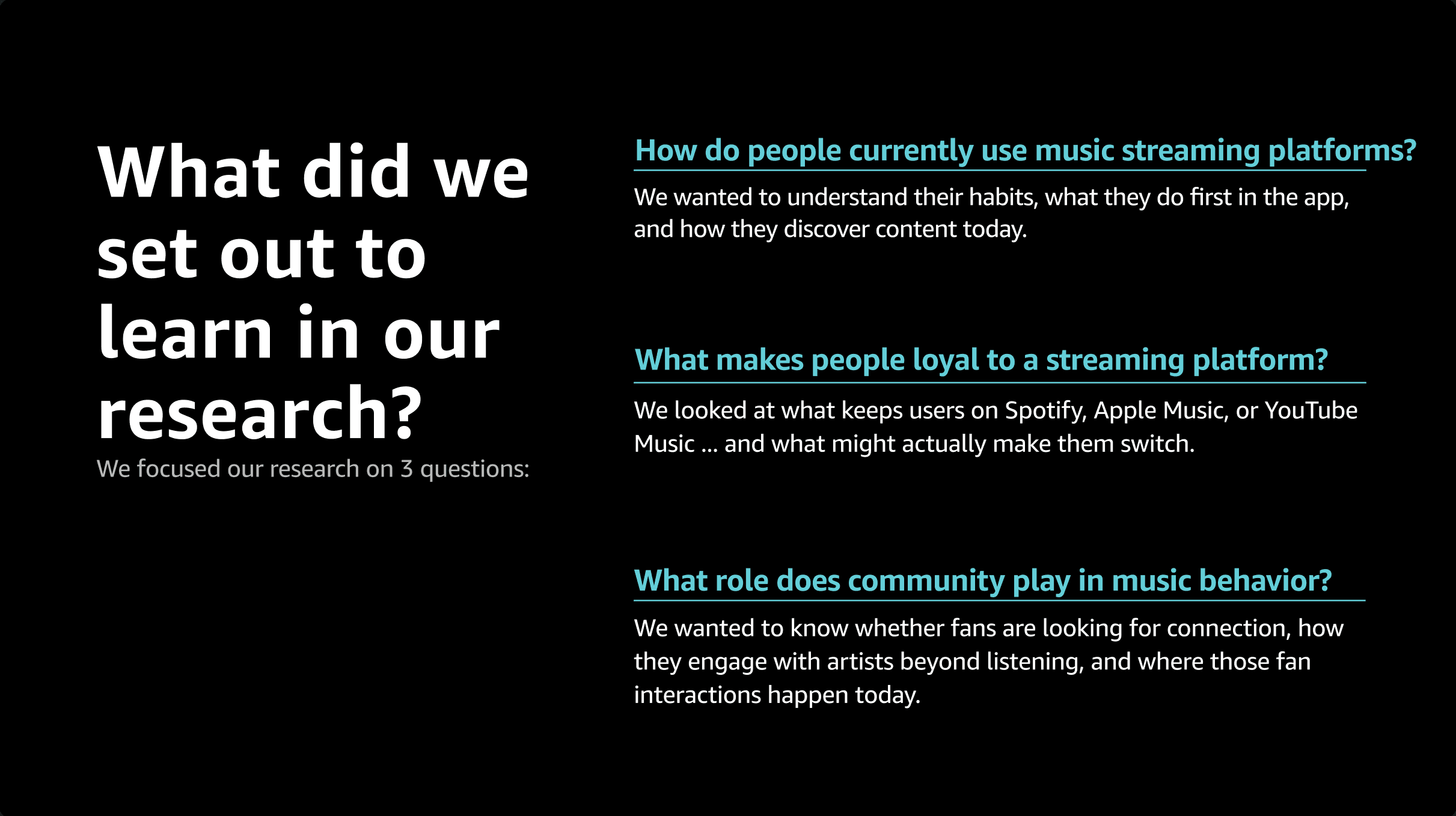
We wanted both breadth and depth: surveys helped us spot behavior patterns, interviews helped us understand the "why," and competitive and secondary research helped us see where Amazon Music could differentiate.
37
Survey Respondents
9
User Interviews
3
Key Competitors Analyzed
37 survey respondents — to understand audio streaming habits and music discovery behavior
9 user interviews — to go deeper on motivations, frustrations, and emotional behavior around music fandom
3 competitors analyzed — to compare how leading platforms support discovery, onboarding, and fan engagement
What We Heard
"If the streaming platform could somehow lead to unique content or having something benefit you in real life, I think that would draw me in." — Interviewee 4
"I want to listen to music before their upcoming album drop with my friends, even if we're not in the same place. I wish there was more ways to do things with your friends.” — Interviewee 3
What Fans Have Now (Competitive Analysis)
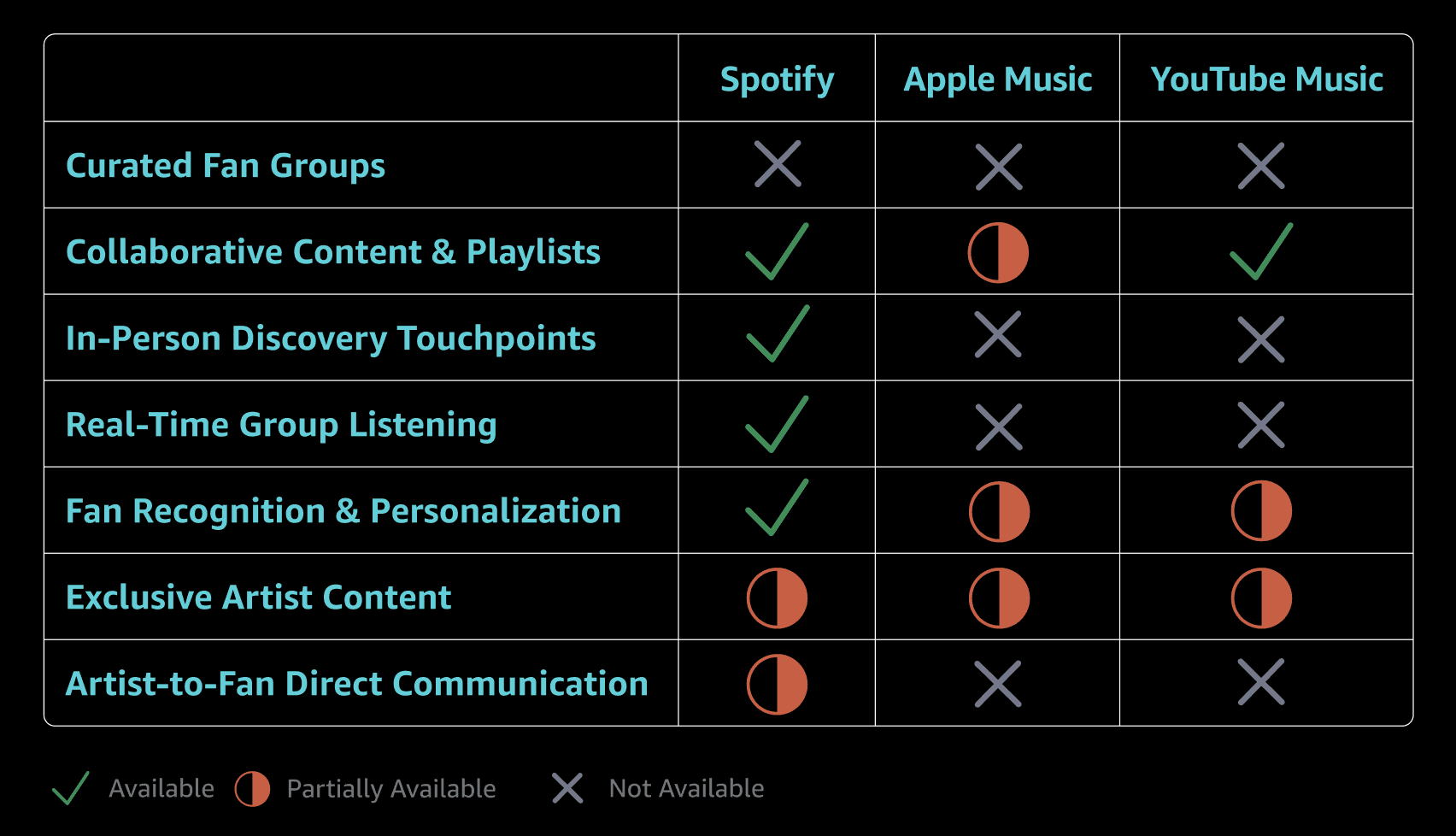
Competitors support listening, but not end-to-end fan engagement. There is an opportunity for Amazon Music to connect in-person discovery + fan communities + shared listening + recognition into one experience.
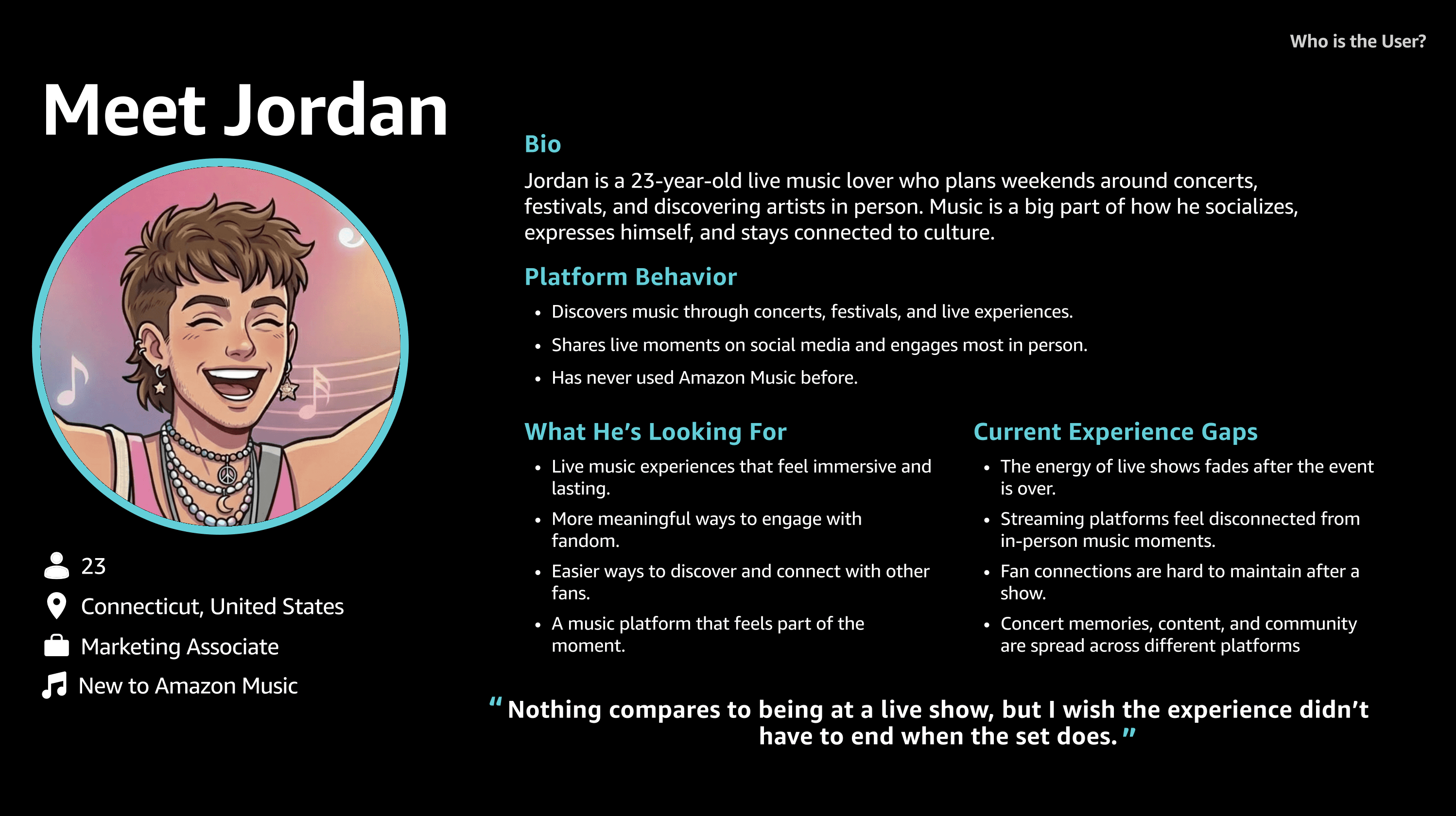
Our Problem Statement
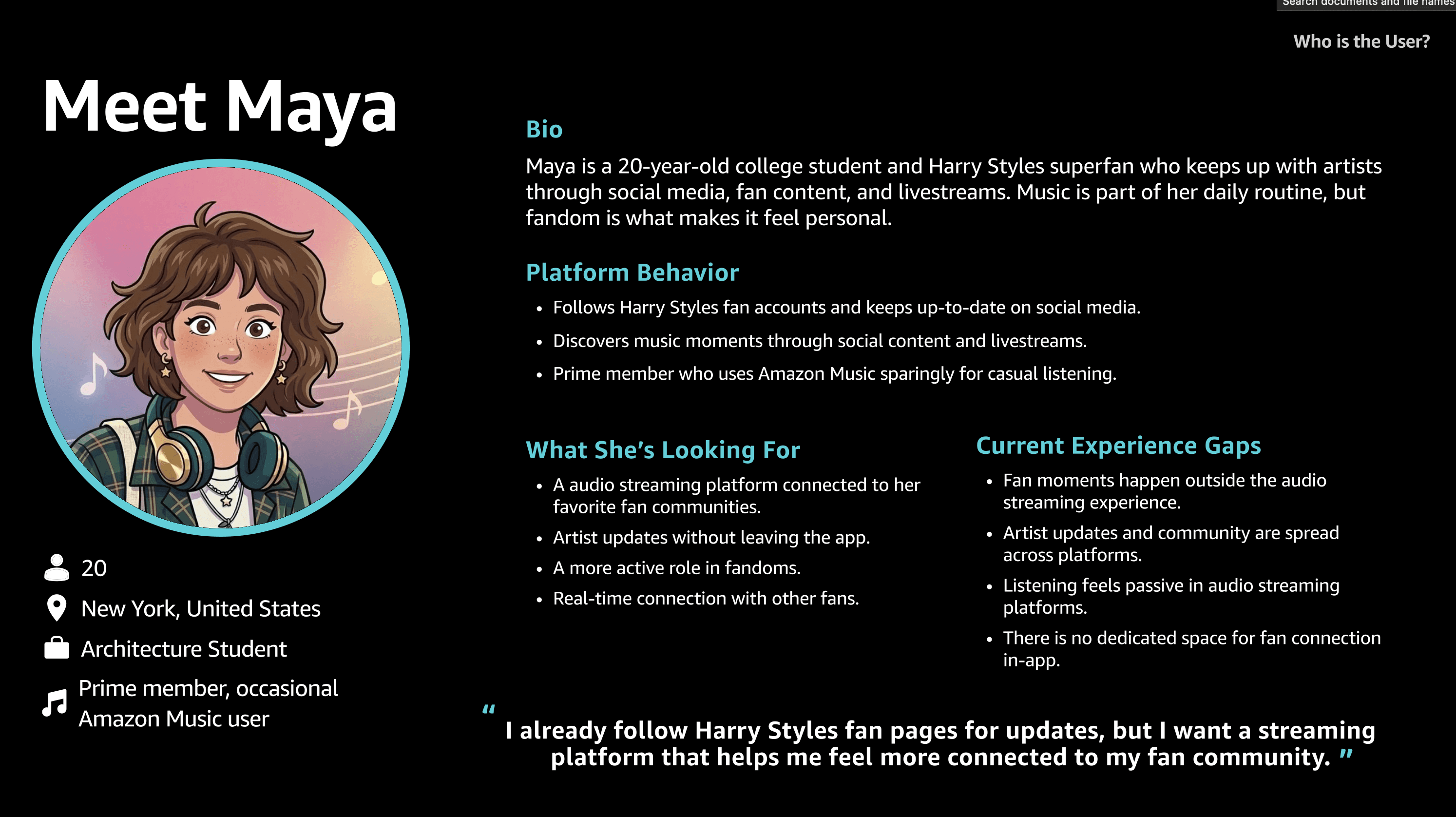
As a devoted music fan, I want a dedicated space within Amazon Music to connect and interact with other fans of my favorite artist(s) so that I can share experiences, celebrate milestones, and feel part of a meaningful fan community.
Our "How Might We…" Statement
"How might we transform Amazon Music into the go-to destination for engaged fans to find their community, share experiences, and celebrate the artists they're passionate about?"
The Storyboard - Discovery Happens in the Moments Fans Already Live
Two fans. Two entry points. One place they both call home.
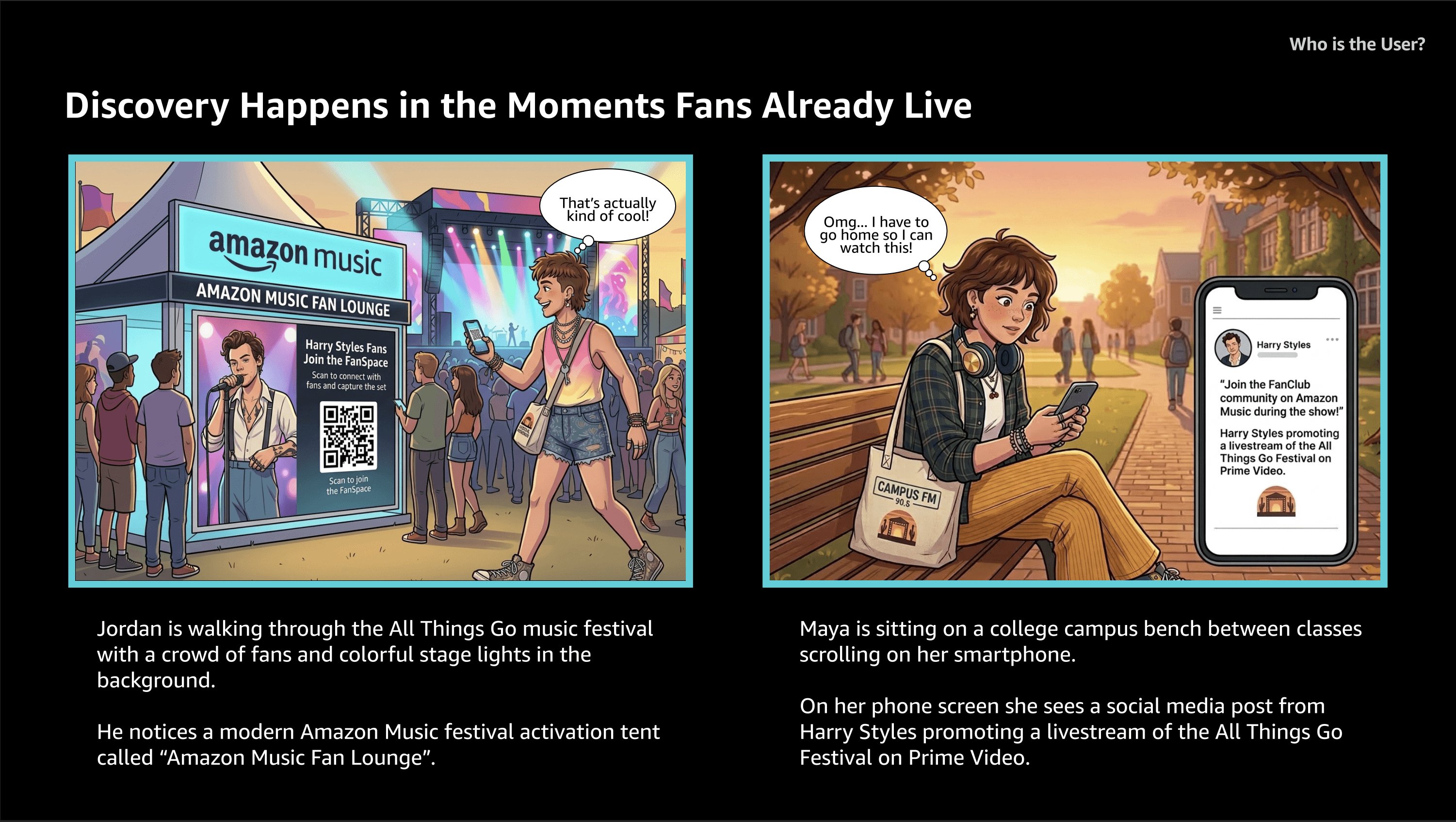
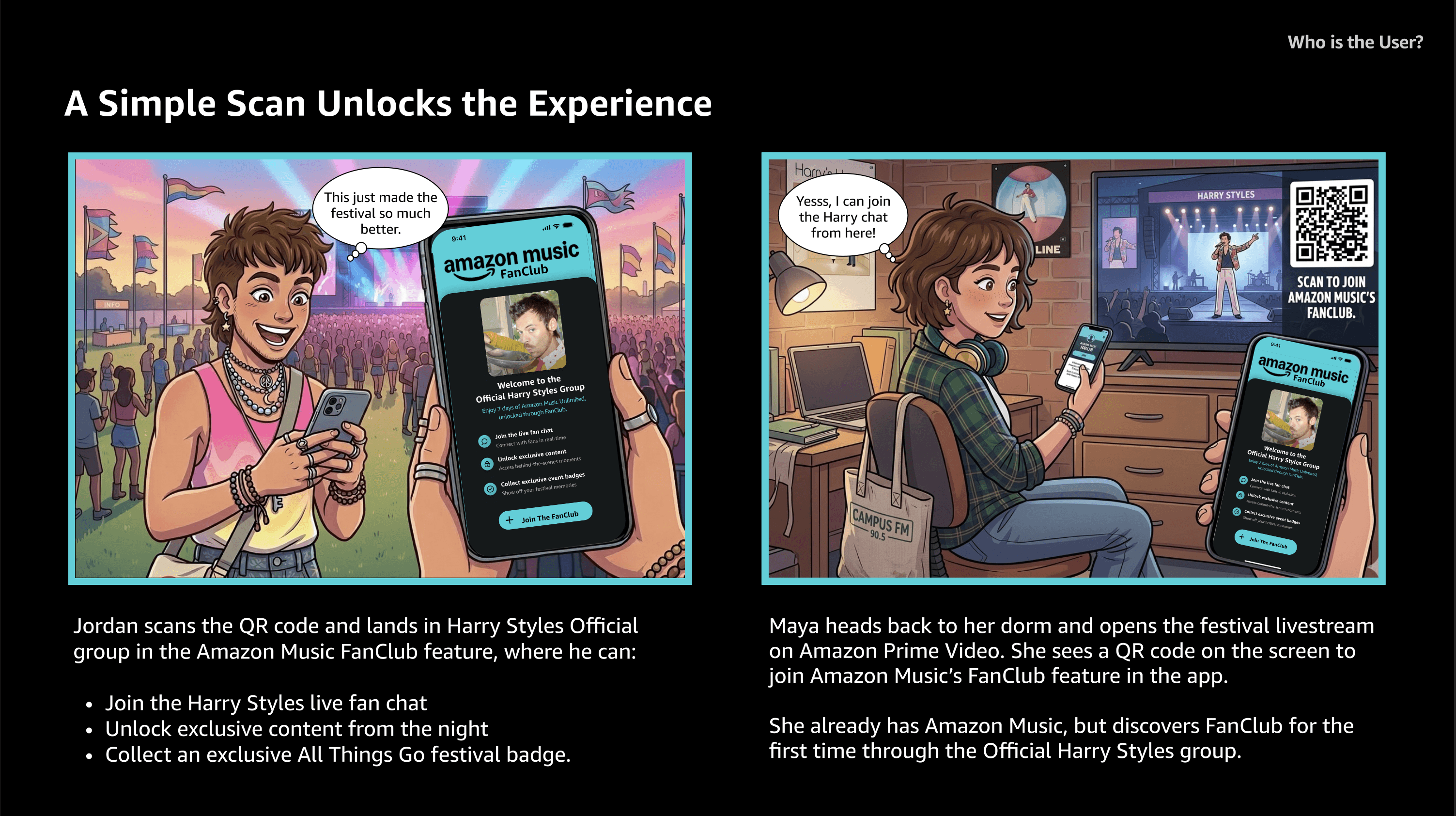
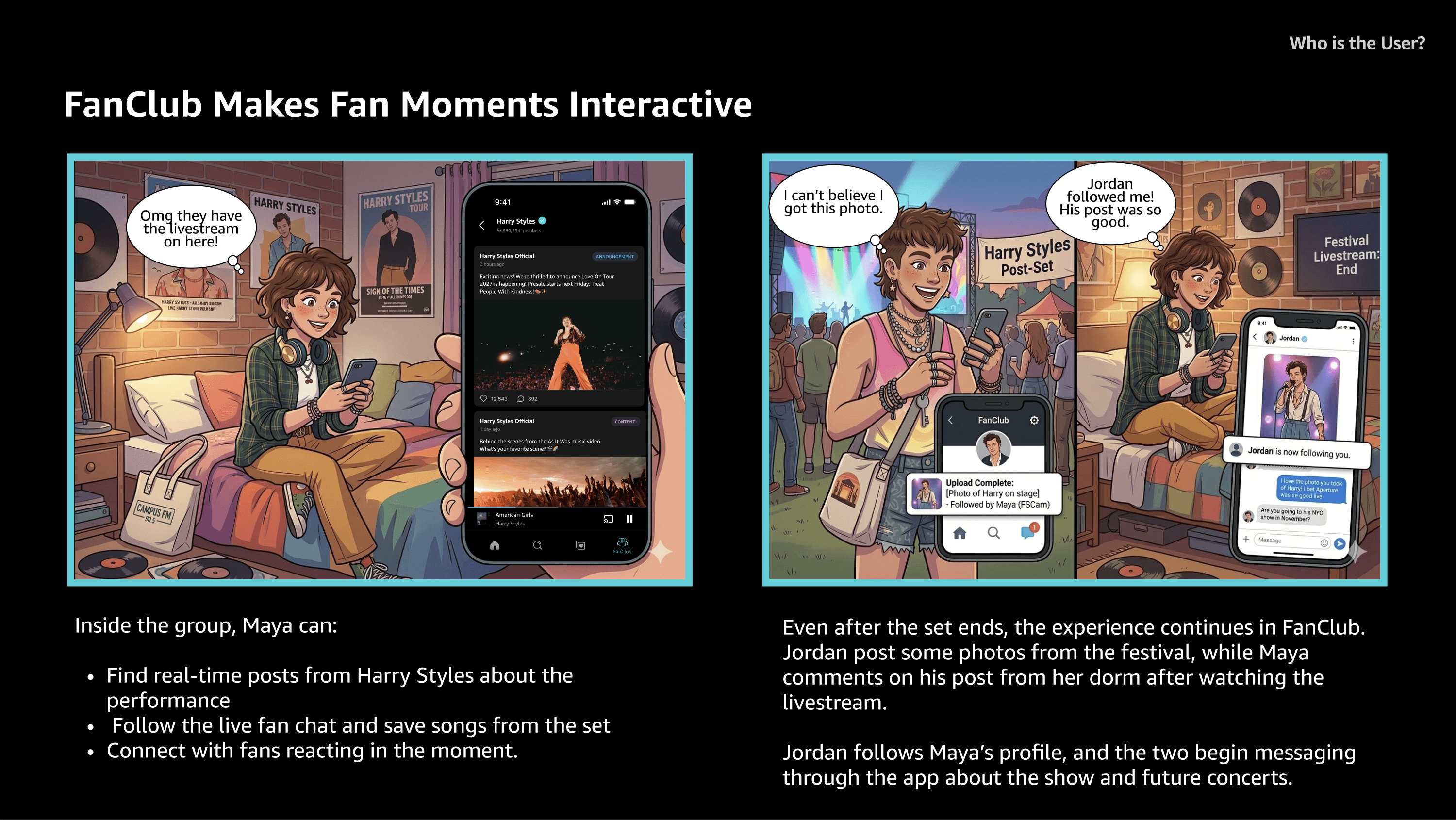
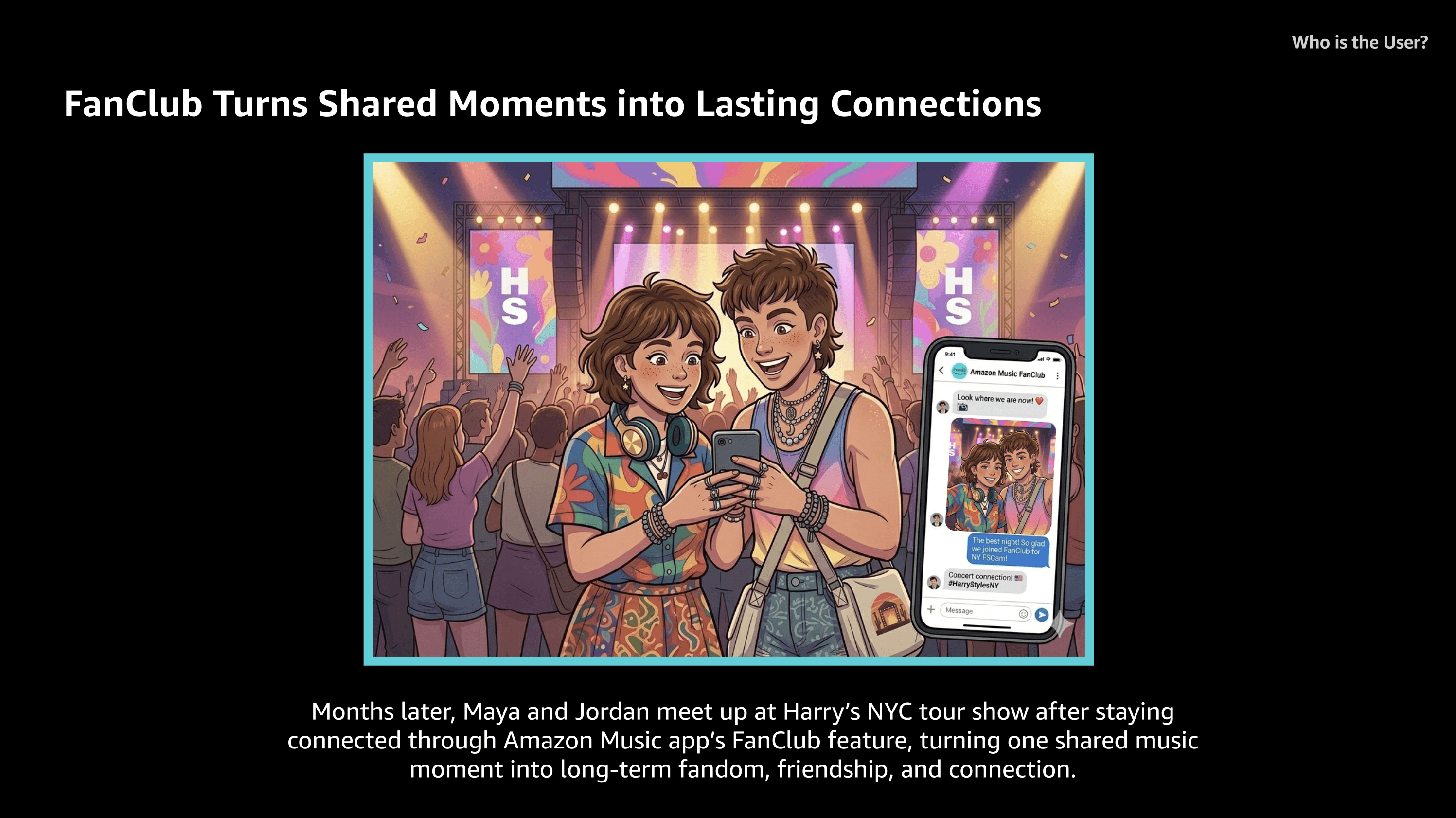
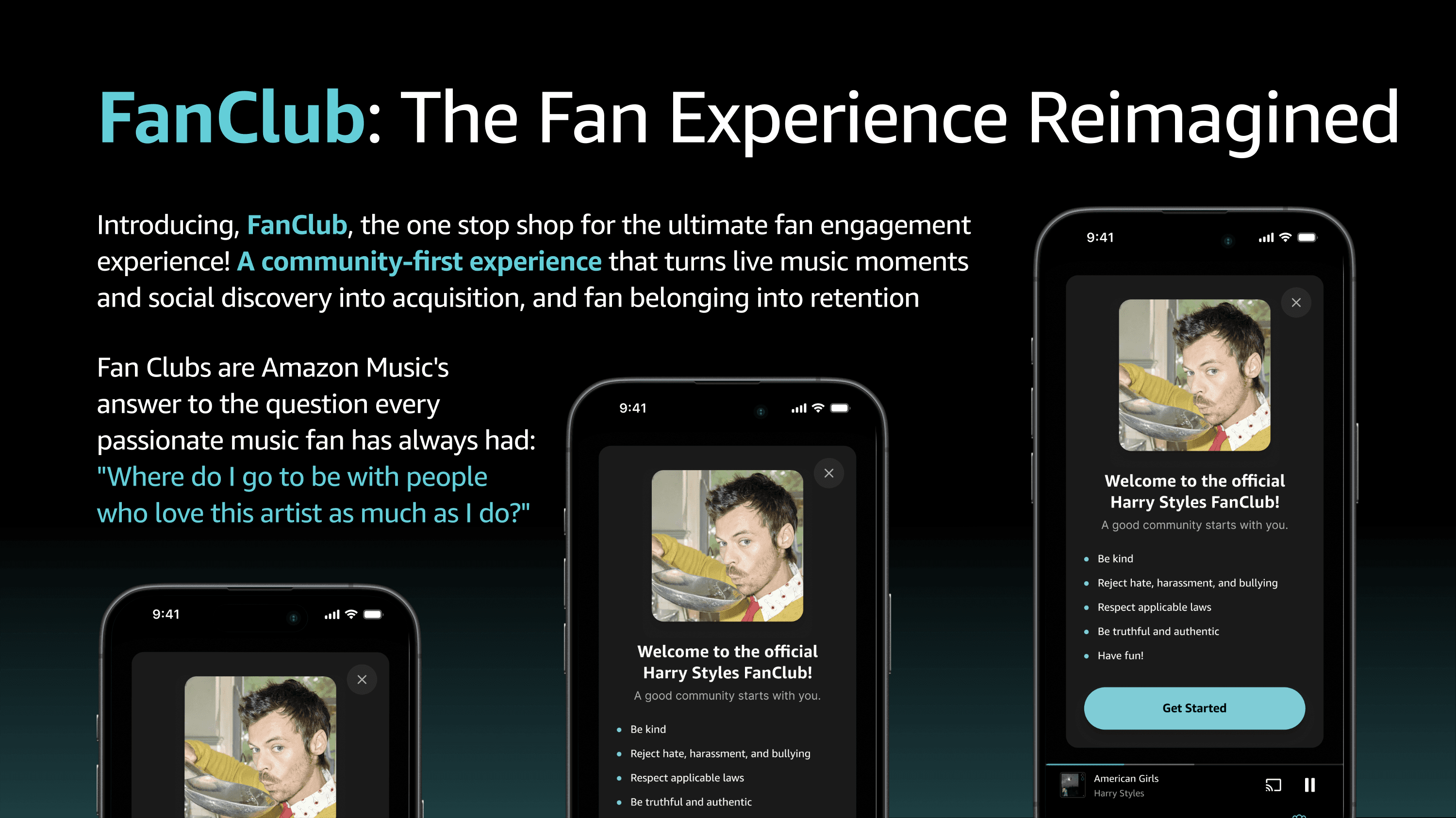
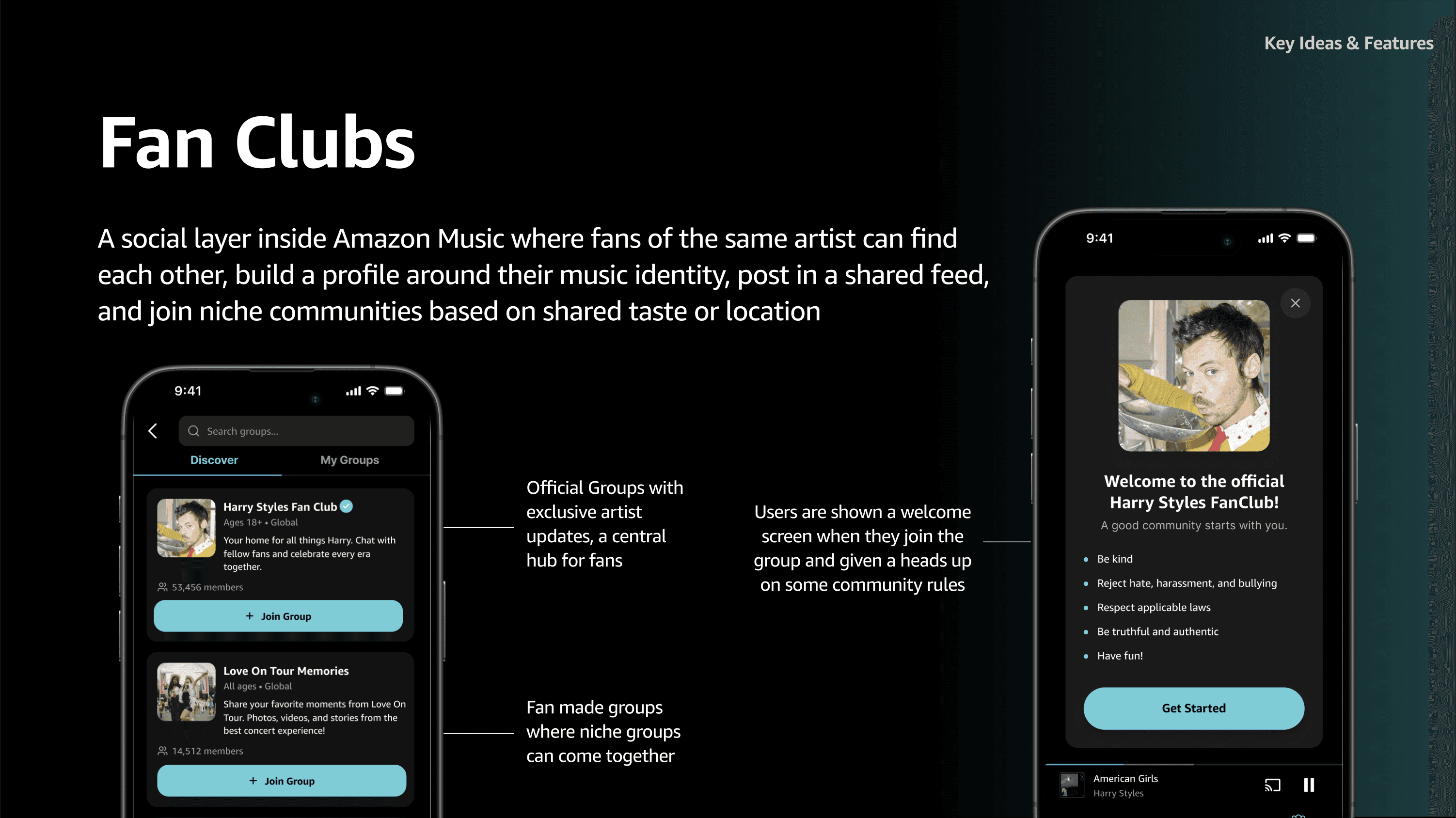
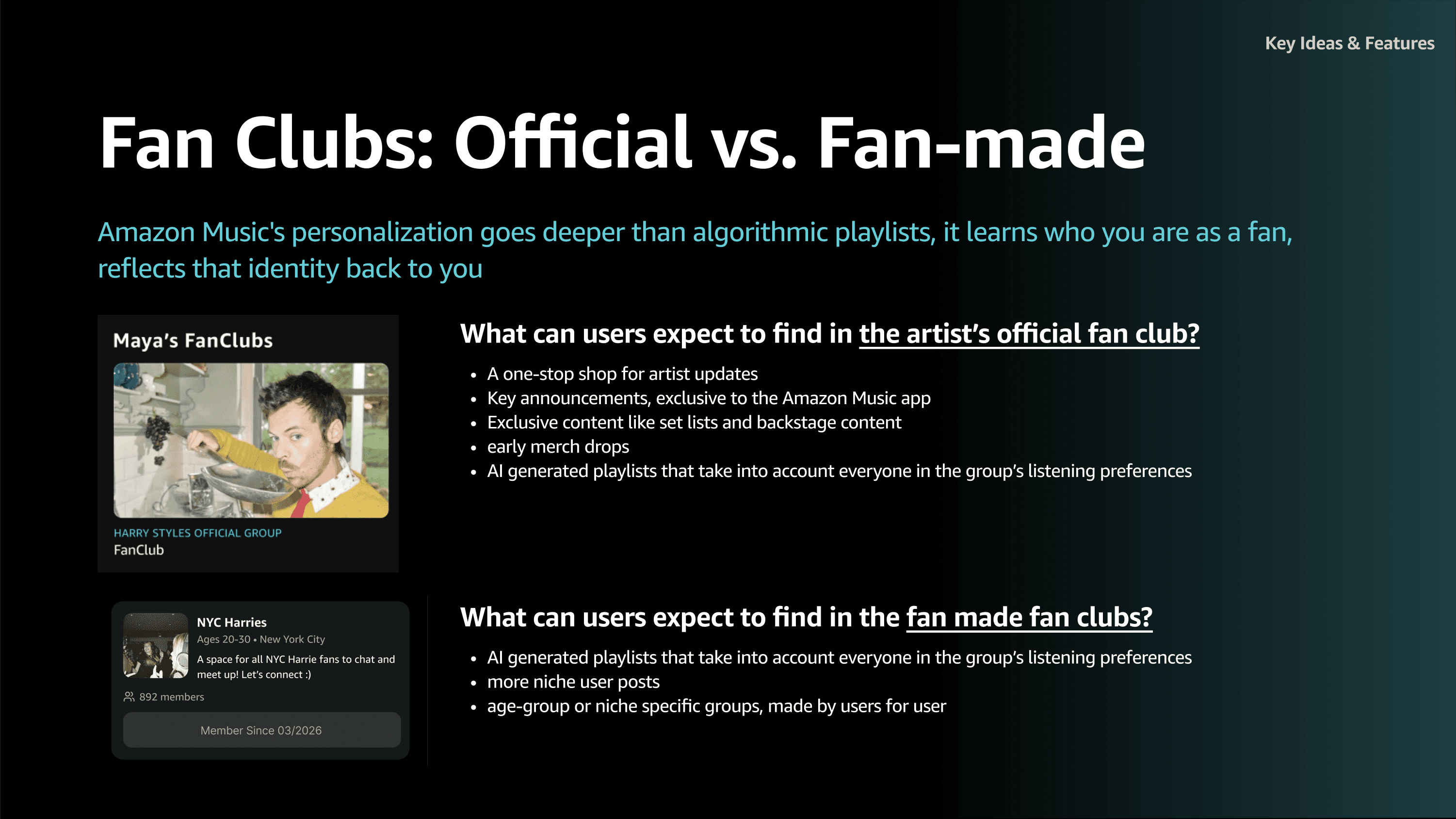
Our Key Features (pictured in the slideshow above!)
Feature 1 — Fan Clubs: Official vs. Fan-Made A social layer where fans find each other, post in a shared feed, and join niche communities based on shared taste or location. Official Fan Clubs are artist-run hubs featuring exclusive announcements, setlists, backstage content, early merch drops, and AI-generated group playlists. Fan-made clubs are user-created spaces for niche communities like age groups, cities, and eras, with their own group playlists and discussion.
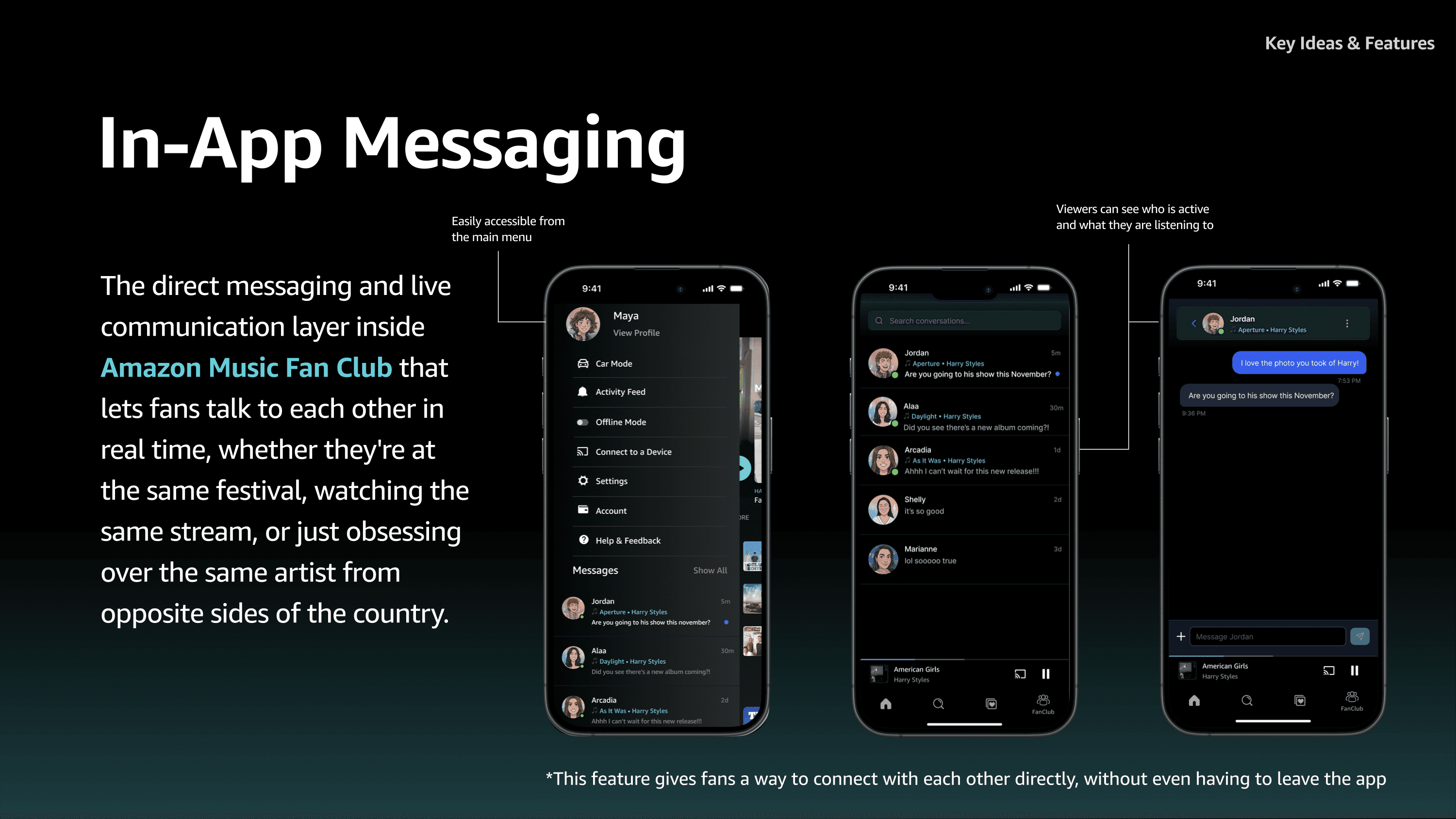
Feature 2 — In-App Messaging Direct messaging between fans, accessible from the main menu. Users can see who is active and what they are currently listening to, making it easy to connect without ever leaving the app.
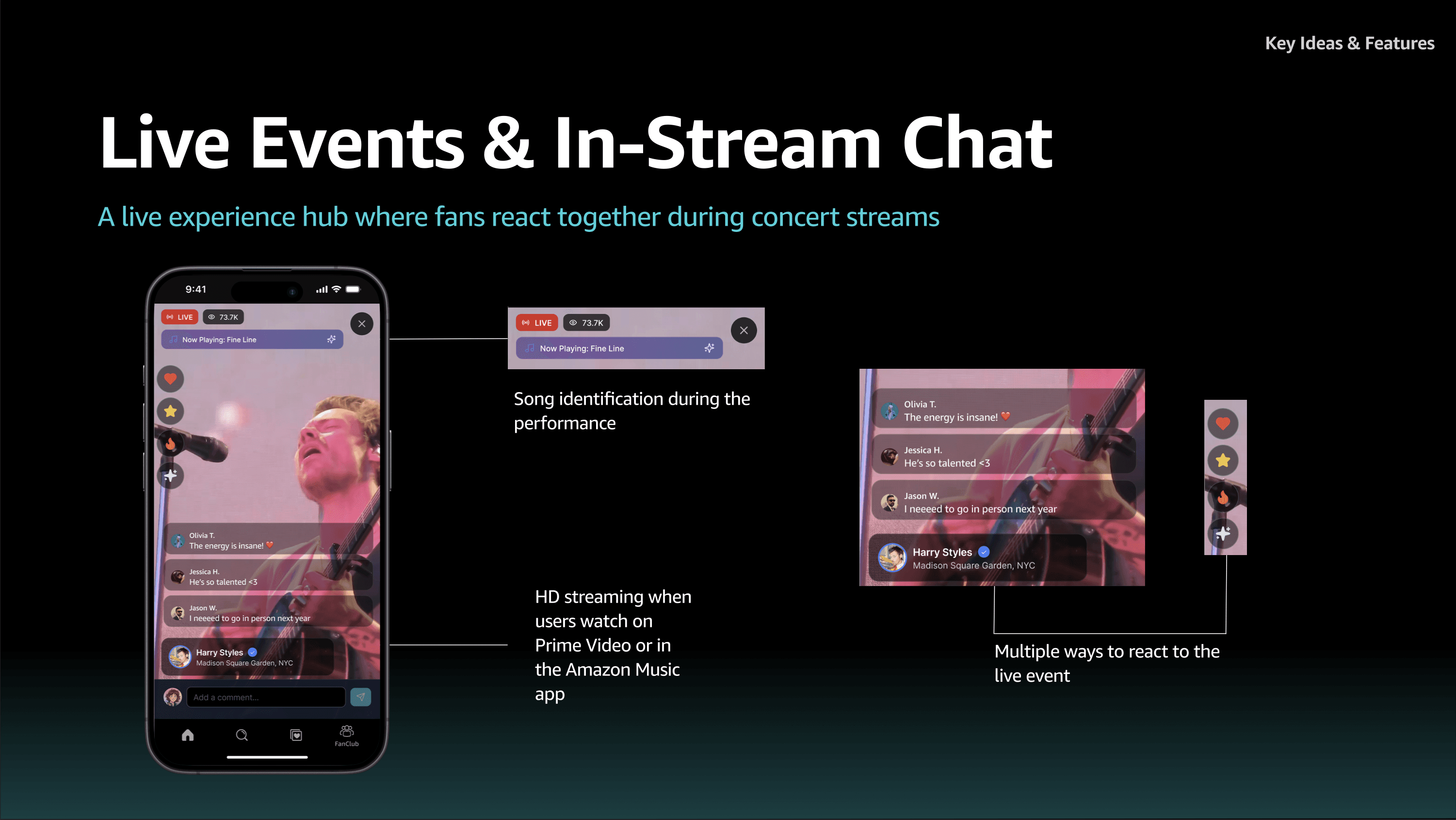
Feature 3 — Live Events & In-Stream Chat A live hub where fans react together during concert streams. Includes real-time song identification, HD streaming via Prime Video or the Amazon Music app, and multiple reaction options during the performance.
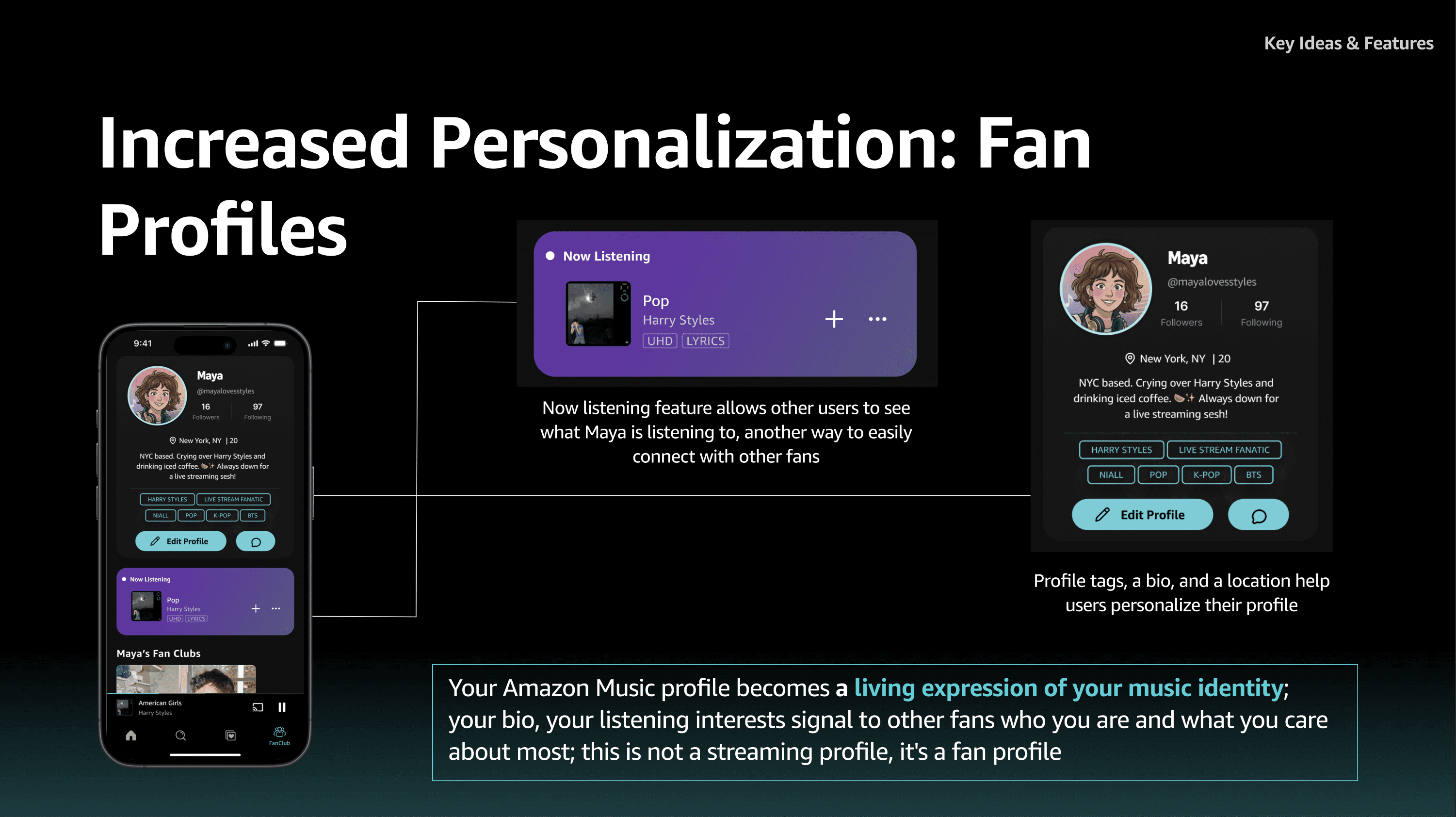
Feature 4 — Fan Profiles A living expression of your music identity, not just a streaming profile. Includes a bio, profile tags, location, follower counts, and a Now Listening status so other fans can see what you are playing in real time.
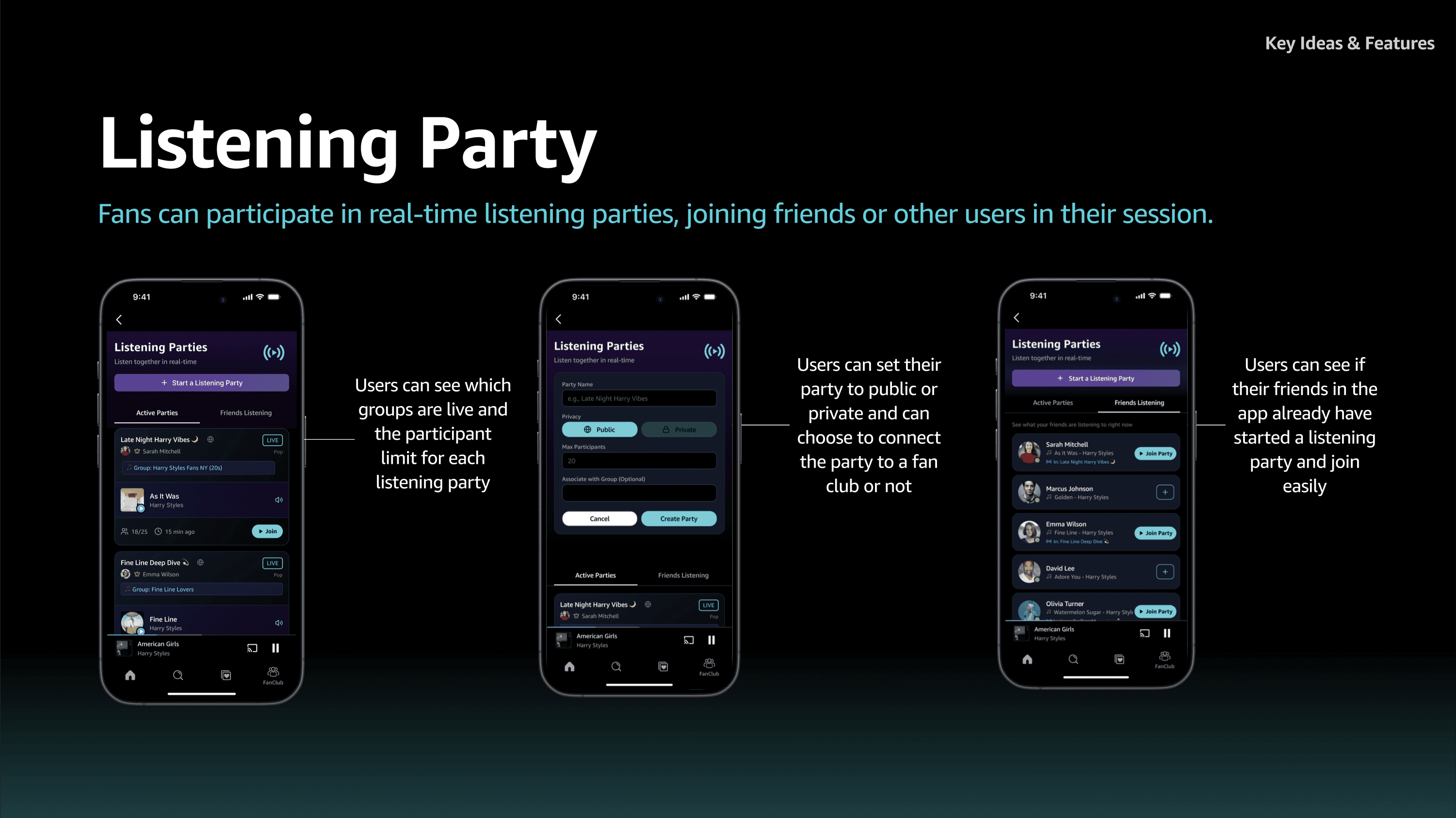
Feature 5 — Listening Party Real-time shared listening sessions that can be set to public or private and optionally linked to a Fan Club. Users can browse active parties, see participant limits, and join friends who are already listening.
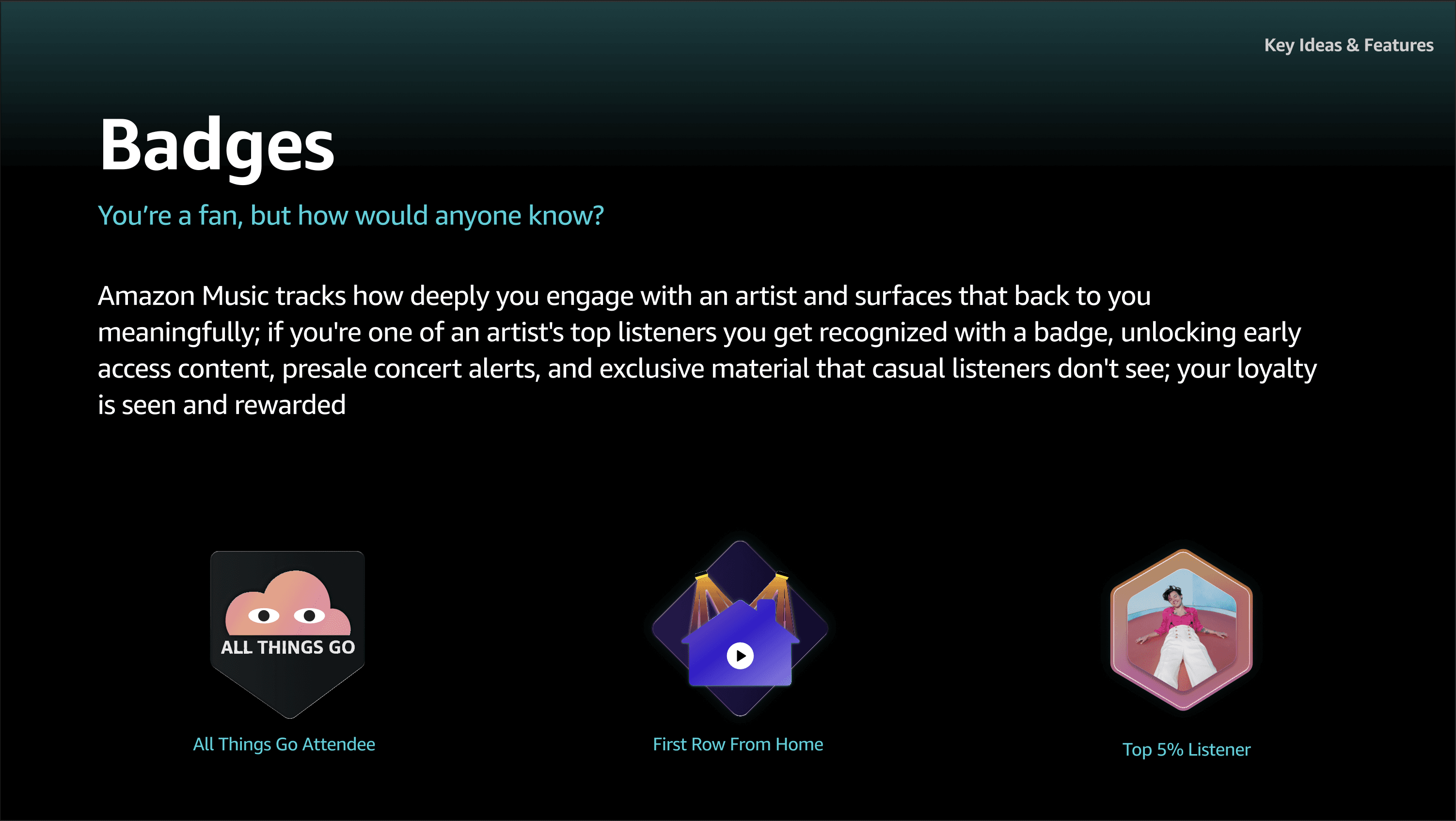
Feature 6 — Badges "You're a fan, but how would anyone know?" Amazon Music recognizes your loyalty with badges that unlock early access content, presale alerts, and exclusive material. Three badge types were designed: All Things Go Attendee, First Row From Home, and Top 5% Listener.
Design Validation
Method: Moderated Usability Testing with 5 Participants
Key problems identified:
Profile page felt too long and overwhelming
Users wanted more direct access to messages and joined groups
Lack of back navigation between screens
Solution and iteration: Simplified the profile page and made it a central navigation hub for fans to access their groups, listening parties, and messages from one place. We also added back naviagtion.
What participants said:
"These features would allow me to engage more going from tab to tab or doing things like watching a live stream event."
"The fan club thing is so cool! It's a good way to meet other people, especially for smaller artists."
"I think it's such a cool idea to have a remote listening party with songs curated by other fans just like me, so I can trust the music will be good."
Reflection
What worked well
The dual-persona storyboard served well in representing our users in a way that resonates with audiences and showcases real moments users might encounter.
The competitive analysis gave the solution credibility and a solid foundation for further developing our concept.
What we would do differently
We would explore the artist side of the experience more deeply, since artist participation is central to what makes Official Fan Clubs valuable but we only designed from the fan perspective.
Five usability testing participants gave us directional signal but not statistical confidence; with more time we would run a second round of testing after our iterations to confirm the profile simplification actually solved the navigation problem we identified
What we learned
Community is a more powerful retention driver than catalog, users want more than just a individual experience with their streaming platform.
The highest-intent acquisition moments happen in the physical world, not inside the app. Meeting fans at a festival or during a livestream could be more powerful than any algorithm-driven recommendation
Designing within an existing ecosystem (Prime, Prime Video, etc.) is itself a competitive advantage.
Conclusion - By the Fans, for the Fans
Amazon Music isn't just where you stream music... it's where you belong to it.
Maya didn't download Amazon Music because of a playlist. Jordan didn't stay because of an algorithm. They stayed because their people were already there.